
Call us: 1800 313 7800
Steel Reinforcement Rebar: The Backbone of Modern Concrete
Key Takeaways
-
- Steel Reinforcement Rebar transforms concrete into a strong, flexible composite by compensating for concrete’s weakness in tension.
-
- Common types include deformed bars, plain bars, welded wire fabric, epoxy-coated, stainless steel, and galvanized rebar, each suited for specific environments.
-
- Steel and concrete bond mechanically and chemically, expanding similarly with temperature changes to maintain structural integrity.
-
- Proper design, placement, and installation of rebar are critical to prevent costly structural failures.
-
- Advances like epoxy coatings, prefabricated cages, and digital modeling (BIM) are improving durability and construction efficiency.
When passing by a construction site, most people notice the large cranes, the cement trucks, and the moving trucks. What they do not know about is the true strength that is hidden within the structure. The steel reinforcement rebar that makes everything rigid.
Also known as rebar, Steel Reinforcement Rebar is a type of steel. That is the secret element that transforms concrete from a dry, brittle material. That performs well under compression into the strong, flexible base that supports modern architecture. Without rebar, we wouldn’t have skyscrapers reaching to the sky, bridges. That span rivers, and your driveway would crumble in a few seasons.
In this blog, we will also look at various types of rebars and how they are used, as rebars are used in every major construction task.
Why Concrete Alone Isn’t Enough?
Concrete is a great material for compressive strength. We can put tons of weight on it and it won’t give way or buckle. But when it comes to tensile stress, that is, pull or stretch, it fails. It cracks, and once it does crack, its structural integrity falls off a cliff.
Concrete works well in compression, whereas steel works well in tension. The result is a composite material, which we call reinforced concrete, a material. That is stronger and more durable than either of the individual components.
When selecting reinforcement steel for real-world projects, matching the rebar grade to your specific structural load and environmental exposure makes all the difference. For standard multi-story residential frames and foundation footings, upgrading from basic mild steel to high-ductility Fe 500D TMT bars provides the critical elongation needed to absorb lateral seismic shocks without sudden brittle failure. Meanwhile, if you are building in coastal, high-moisture, or chemical-heavy zones, relying on un-coated carbon steel is a ticking clock—investing in Corrosion-Resistant Element (CRS) or epoxy-coated rebar prevents internal rust expansion that gradually spalls concrete from the inside out.
What Exactly Is Steel Reinforcement Rebar?
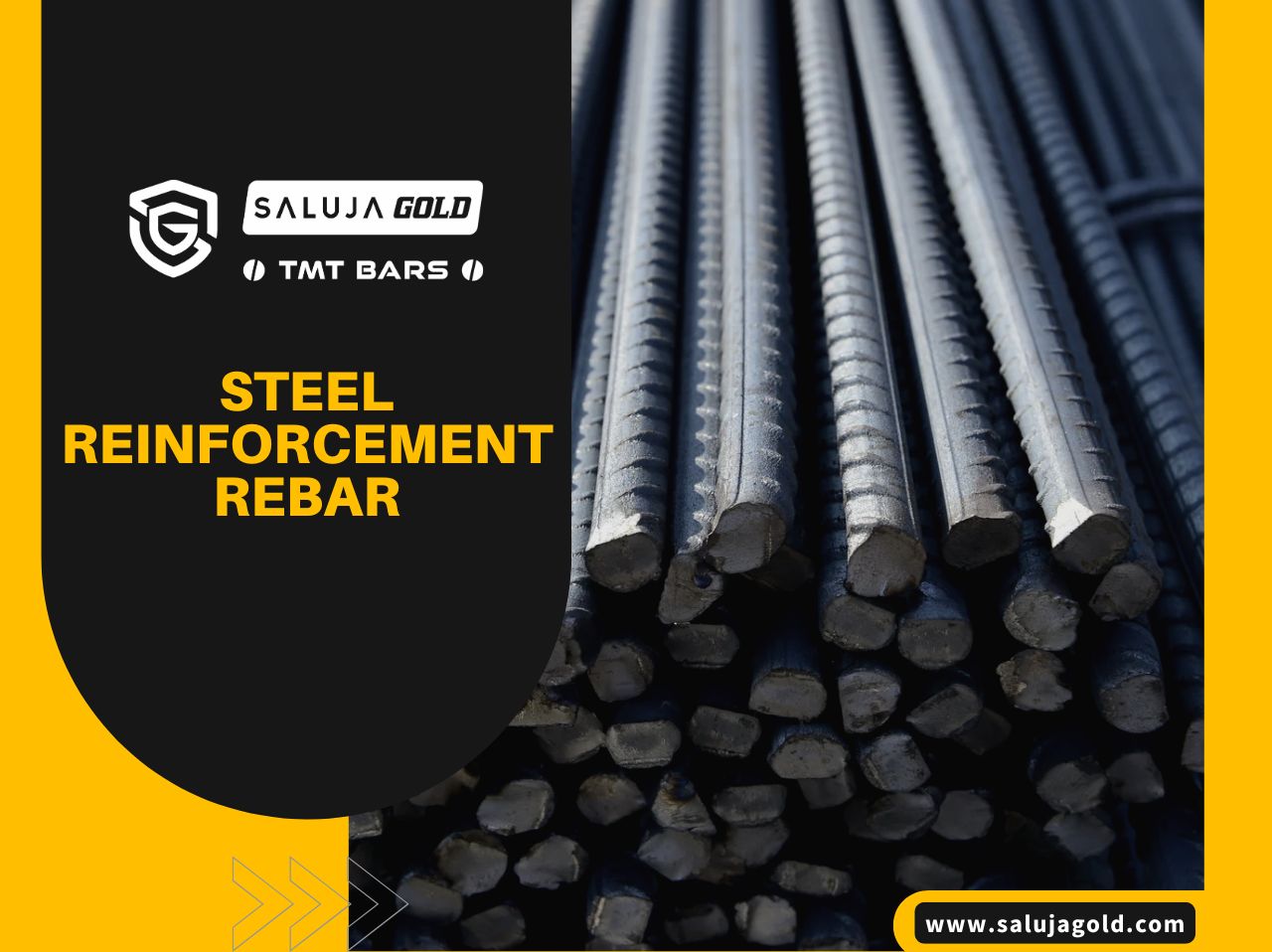
Steel reinforcement, also known as rebar, is a piece of steel. That is usually ribbed or deformed and is put into concrete to increase its tensile strength. The ribs or ridges on the surface cause the rebar to bind well into the concrete. Which in turn causes the two materials to act as one when stressed.
Most of the time, carbon steel is used for making rebar, which we choose because it expands and contracts at almost the same rate as concrete does when temperatures change. This is very important. If steel were to expand more than the concrete on a hot day, it would cause the structure to crack. But with equal expansion rates, they do that which is seen in different seasons and climates.
Types of Rebar And Where They Do Best?
As the base concept is the same, what we have is a variety of rebar for different environments and projects. We have many types of steel reinforcement rebar, each with a specific use.
-
- Deformed Steel Bars – We see these most often, which have ribbed surfaces for maximum bond in concrete. Used in beams, columns and slabs.
-
- Plain Round Bars – Smooth surfaced, easy to cut and bend. Used in light reinforcement or temporary structures.
-
- Welded Wire Fabric (WWF) – Mesh grids that are perfect for slab reinforcement. Also great for load distribution over large areas.
-
- Epoxy Coated Rebar – This is for use in marine and industrial settings.
-
- Stainless steel rebar– It has great corrosion resistance, which is why it’s great for critical infrastructure, though it does come at a higher price.
-
- Galvanised Steel Reinforcement – It has the benefit of moderate corrosion resistance at a lower price point than stainless steel.
How Steel and Concrete Work Together?
It seems to be an easy task putting steel inside wet cement; however, the principles of how it all works together are interesting. Steel is very strong under tensile (pulling or stretching) load, which is why it works well in tension.
Concrete has a very low tensile strength, but it can handle compression very well. These characteristics of steel and concrete are a perfect fit with the use of steel reinforcement rebar, as the two materials are intended to be used together.
-
- Mechanically, the ridges and rough surface of the rebar hold and grip the concrete, making them both work together as a single solid object.
-
- Chemically, the naturally high alkaline environment of concrete protects the steel reinforcement from rusting.
-
- Physically, steel and concrete expand and contract at almost the same rate when temperature changes occur, which helps hold them together with little to no risk of separation.
Where Will You See Rebar Reinforcing Steel?
In all applications that require heavy loads to be carried or for resistance to cracking over the years, rebar is the solution.
-
- Skyscrapers that oscillate in the wind without damage.
-
- Bridges carrying thousands of vehicles daily.
-
- Foundations that transfer structural weight to the ground.
-
- Massive walls that hold back tons of soil.
-
- Highway and airport runways are in continuous use.
-
- In your driveway as well as in large-scale hydroelectric dams, the role is justifiable.
The Process of Installing Rebar
The process of installing steel reinforcement rebar in a construction site is much complex than we see, and each step is important so the structure can be safe, and last long.
-
- Design & Planning – Engineers determine the size of the rebar, the quantity, and the location.
-
- Cutting & Bending – The steel bars are cut and bent to different shapes either in a shop or on-site.
-
- Placing – Workers place the rebar in the location as found in the grids or as drawn in the drawings.
-
- Tying – Once in the right location, they tie the bars together with steel wires so they do not move when the concrete is poured.
-
- Maintaining Cover – Small plastic spacers are put under the bars; this is done so the bars are sufficiently deep in the concrete and protected from water and rust.
-
- Pour the Concrete – The concrete is poured around the rebar, and is shaken, or can also be vibrated to ensure the concrete fills all voids while removing air pockets.
If only one step is missed, the structure may be weakened, and repairs will need to take place sooner rather than later.
Common Rebar Mistakes That Can Cost Millions
A huge cause of issues with buildings and structures is poor rebar work. Some common mistakes are:
-
- Using the wrong size or type of rebar for the load.
-
- Placing rebar too close to the surface causes rust.
-
- Poor tying or fixing bars leading to movement while pouring.
-
- Poor overlaps or wrong fitting of bars cause weak points.
-
- Not checking and inspecting the work before pouring the concrete.
Once the concrete hardens, correcting these mistakes is nearly impossible. For this reason, it’s always better to prevent them in the first place.
The Future Of Reinforcement
The construction industry is always changing, and so is the way we use steel reinforcement rebar. We are now starting to see typical use of epoxy-coated and stainless steel rebars in more adverse conditions, along with a wider variety of projects benefiting from the long-term durability of these materials. The advent of pre-fabricated rebar cages has also allowed for faster and more accurate installation.
Advanced materials like fibreglass reinforced polymers are also starting to be introduced for certain types of high-performance projects that demand extremely high resistance to rust and corrosion.
On the digital front, new technologies such as Building Information Modelling (BIM) will allow engineers to test how rebar behaves under heavy loading conditions, and help engineers remediate errors before the first bar is installed. This reduces error and waste. Slowly but surely, we are learning how to make our designs smarter and stronger using reinforcement that will help support the highly complex forms of the future.
Beyond picking the right specification, long-term structural integrity boils down to site management and installation discipline. Simple job-site mistakes—like letting rebar rest directly on bare earth where moisture triggers early oxidation, or bending bars cold without proper radius tools—can compromise up to 30% of the steel’s designed yield strength. Always ensure your team uses quality plastic spacers to maintain a strict clear concrete cover, stacks raw bundles off the ground on raised sleepers, and verifies mill test certificates before pouring. Taking these practical steps guarantees your structure stays safe, compliant, and maintenance-free for decades.
The Strength You Never See
The time comes around when you cross a bridge, park in a high-rise garage, or even pull into your garage, and think that this is what you see is the concrete, but what you don’t see are the steel reinforcements, which are the real heroes. These background steel bars, grids and meshes are silent sentinels out there to see you through what life and nature do to the structure.
In the past, we may have taken steel reinforcement rebar for granted, but today we can not have modern construction without it. If you are starting a construction project, don’t go with concrete as a single choice; talk to an engineer about the Best Rebar Reinforcing Steel for your application. That choice today will bring you safety and strength for decades to come.